

Singapore is a nation held in incredibly high esteem by most people around the world. It boasts extremely high HDI numbers and is regularly ranked as one of the world's premier destinations for permanent residence and expatriate relocation. This reputation is due to myriad factors, not least of which are that it has a stable political system, is incredibly safe, boasts world-class infrastructure, has a favourable tax framework and is at the crossroads of Western nations and Asia.
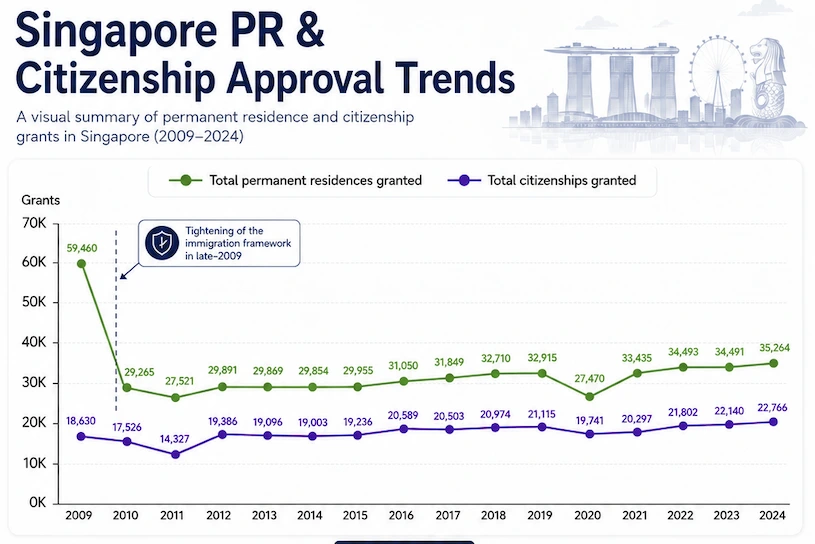
But with these incredible advantages comes a comparatively challenging application process. According to some data, the approval rate can vary, but in 2024, only 35,264 were approved (with an average of 33,000 for the past five years). Although no official statistics are published, the evidence indicates that only those who meet Singapore's Immigration & Checkpoints Authority's (ICA) stringent application criteria are approved.
Singapore PR Approval Rate 2026: What the Data Actually Shows
For many individuals who have been S Pass or Employment Pass (EP) holders for some time, the desire to permanently relocate to the city-state is understandable. This sentiment is also true for almost anyone who happens to be in a position where this scenario is possible (a spouse of a Singaporean citizen or another form of long-term resident for instance). But the reality is that becoming a Permanent Resident (PR) involves several steps and meeting specific criteria that could result in a failure of their application to proceed, many never knowing the reasons why.
The unfortunate truth is that far too many applicants rely on outdated or anecdotal advice to form their understanding of the process, typically resulting in a failure to meet the required criteria and, ultimately, denial. With a better understanding of ICA statistics, it is possible to eliminate uncertainty and obtain a more accurate picture of reality based on data (even with the aforementioned lack of published statistics). It is also worth noting that different years will result in differing reasons for the number of applicants who are approved:
| Year | New PRs granted | Key context |
|---|---|---|
| 2020 | 27,470 | Pandemic disruptions affected travel and processing. The lower number of approval rates is likely due to constraints caused by COVID. |
| 2021 | 33,435 | Recovery and processing normalisation are possible reasons for the uptick, but it is not officially stated. |
| 2022 | 34,493 | Return to pre-pandemic immigration levels and population stabilisation. |
| 2023 | 34,491 | Continued and sustained PR intake, potentially as a broader process of maintaining demographic and workforce balance. |
| 2024 | 35,264 | A 14-year high is possibly occurring amid long-term demographic challenges, including low fertility and an ageing population. |
| 2026-2030 (Est.) | ~40,000 / year | Conditional estimate only, based on comments by DPM Gan Kim Yong, Committee of Supply Debate, 26 February 2026. |
As a result of the speech made by the Deputy Prime Minister, we can infer that for 2026 and the following four years up to 2030, around 40,000 new PRs will be granted by the ICA (which can still be subject to change).
The Reality Behind "Approval Rates"
Before getting too deep into "official statistics", we have to make it clear that while there are overall numbers (in terms of how many people the ICA expects to approve for PR), they refrain from publishing detailed data on specific evaluation rubrics to:
- Prevent negative sensibilities (both societal and diplomatic)
- Maintain a sovereign and flexible policy that can be updated as circumstances change
- Stop applicants from "gaming" the system
In practice, this approach means that it isn't possible to get anything other than anecdotal data based on nationality or application quality. The need for flexibility also means that past data might not bear any indication of future results. With that said, there are some factors that may offer a glimpse of the application process averages.
| Metric | What it shows | What it doesn't show |
|---|---|---|
| Overall approval rate | General competitiveness of the national intake | An applicant's specific, localised chances of success |
| Approval by pass type | Which employment tiers (EP vs S Pass) succeed more on average | The critical impact of an applicant's individual niche or industry factors |
| Approval by nationality | Broad demographic preferences to maintain the ethnic balance | How the ICA weighs an applicant's personal qualifications and local roots |
| Processing time | The typical administrative timeline for backend verification | A definitive indicator of an application's actual strength |
Understanding Singapore's PR Approval System
Although the process and number of PRs granted may seem random, they are based on real factors aligned with each year's strategic national priorities and longer-term goals. To fully understand the data, you also need insight into how PR applications are evaluated.
How ICA Evaluates PR Applications
As we stated earlier, the ICA avoids stating any form of rubric when evaluating applications to ensure the process is fair and open. As a result of this opaqueness, however, it can cause frustration among applicants. What is clear, though, is that there are some observable patterns that indicate a few distinct frameworks that the ICA may use in their selection process.
- Economic and longevity contributions1: Here, the ICA will take into account several points based on financial stability, baseline salary, and consecutive income tax history.
- Demographic alignment and strategic fit: Singapore has a proud history of maintaining a stable and fair ethnic makeup (in fact, it is an integral aspect of the nation). Consequently, all immigration intakes are often calibrated against the local Chinese, Indian, Malay and so-called "Others" (CMIO) framework to ensure that demographic ratios remain stable.2
- Educational and professional capital: Degrees and other advanced qualifications from prestigious universities and institutions are likely to carry significant weight. Even more so if they demonstrate skill sets that are in demand and not easily filled by the local talent pool.
- Family structure: If you are married to a Singaporean citizen, you are entitled to apply under the Family Ties Scheme but are still evaluated holistically and based on your spouse's profile. If not, the ICA will take into account factors such as whether your children are enrolled in local schools (and therefore more likely to adapt and integrate naturally into Singaporean culture).
- Social integration: Genuine community integration is what is checked for, along with an active, long-term physical residence within the country.
1 A high income in isolation is not a guarantee, and the ICA will check whether an applicant's job exists within a priority industry or addresses local workforce gaps. ↩
2 We can again infer that a falling fertility rate might lead to prioritising younger applicants with longer working horizons to mitigate this issue. ↩
It's important to note that these variables are dynamic and not a universal framework. In other words, the weight of each factor (along with anything else the ICA deems relevant to these kinds of applications) can vary based on the needs of the nation.
Approval Rate By Employment Pass Type
Existing holders of the various employment passes are usually eligible to apply for PR status after a certain amount of time working. While all passes are acceptable, some will be held in higher esteem due to the more stringent criteria used during the application process (i.e., the COMPASS framework for an Employment Pass (EP)).
| Pass type | Key factors |
|---|---|
| Employment Pass (EP) | Gaining an EP requires strict adherence to the COMPASS framework as set out by the Ministry of Manpower (MOM). To obtain this pass, an applicant must demonstrate that they have valuable and recognised educational qualifications and a salary that meets the thresholds (among six other requirements). |
| S Pass | This pass is for mid-level employees and includes various quotas and an employer levy. Broadly speaking, an S Pass will offer the lowest chance of success, and many applicants will opt to upgrade to an EP if applicable to boost their odds. |
| Entrepreneur Pass (EntrePass) | Although holding an EntrePass offers a higher path than some options, approval is possibly milestone-dependent, as with the actual application. |
| Personalised Employment Pass (PEP) | PEP holders offer very high chances of PR application success due to the high salary thresholds required to obtain the pass. And, because PEP holders will have an ideal economic profile under the Professionals, Technical Personnel, and Skilled Workers (PTS) scheme, they already enjoy an advantage. |
To put it simply, the more difficult a work pass is to obtain (based on criteria put forth by the MOM), the more likely it is that a PR applicant will succeed. But as with all the information in this article, there is often more to a PR application than raw numbers alone.
Approval Patterns By Nationality And Region
While no official data is disclosed regarding nationalities and regional acceptance rates, we can again fall back on historical patterns to help us to understand how this element might influence PR application considerations. Just be advised that there might be some bias in this data because the more applicants from a particular nation, the more likely it is that they will be granted permanent residency; however, this is based on averages rather than necessarily the nation.
Nevertheless, the data shows patterns that certain nationalities and regional populations tend to be granted PR more than others, potentially based on the desire to maintain strict CMIO ratios. On average, success patterns are driven by quota density, which is to say, a factor of how many people apply from that region versus how much room is available for that specific group under Singapore's strict ethnic preservation policy.
| Region / nationality | Estimated success tier (relative to applicant pool size) | Contributing factors |
|---|---|---|
| ASEAN (predominantly Malaysia and Indonesia) | Higher approval rates | Regional integration and cultural proximity to Singapore. |
| China | Moderate to high | Large applicant pool and higher ratio of Chinese in the CMIO framework (around 74.3%). |
| India | Moderate | A substantial application pool results in a higher level of competition. When combined with a lower CMIO ratio of 9%, it can cause lower per capita approval rates. |
| UK, US, Australia | Moderate | Classed in the "Others" demographic category, which historically comprises roughly 3% of the resident population. While applicants frequently boast elite professional profiles (EP/PEP holders), the tiny structural quota makes selection highly competitive and volatile. |
| Other countries | Variable | Strongly depends on individual profile strengths. |
What Actually Impacts Your PR Approval Chances
As we have made efforts to note so far, the lack of official published data and evaluation criteria makes it particularly challenging to offer insightful measures of what impacts a PR application. Further, due to the holistic nature of the process, raw numbers alone cannot tell a complete story, and there are myriad other factors that can both boost an applicant's odds as well as diminish them.
Factors That Significantly Improve Approval Odds
Beyond statistics and data, there are certain variables that are more likely to influence a positive outcome, including (but not limited to):
- Salary levels and economic contribution: Those on the higher end of salary thresholds (whether related to an EP or S Pass) are more likely to be approved. Connected to this point is evidence of regular tax contribution history, indicating that the applicant is actively contributing financially to the state.
- Length of residence: 2 to 3 years of continuous residence is often the minimum required to apply, but longer residence stays of 4 years or more might be looked at more favourably (in terms of integration).
- Educational qualifications: Recognised degrees from top institutions (possibly as listed by the MOM) or any certifications or skill sets that align with current economic priorities are key indicators of a strong profile.
- Family ties within Singapore: Those with some familial connection to Singapore likely have an additional advantage over those without. Such connections might include having a spouse with PR or citizenship, children who were born in Singapore and/or study locally, or parents who are PRs or citizens.
- Age and career stage: If an applicant is too young, they may not have enough work experience or have made a sufficient contribution to the country. Too old and integration concerns begin to intensify. What the age thresholds are (if any) are not publicly available.
- Evidence of community integration: Evidence of volunteer work or membership in professional organisations can improve their standing when applying for PR. Property ownership can also help, but as we will cover later, it's a weak positive signal at best.
Factors That Hurt Your Application
Likewise, there are also elements that can negatively impact a PR application. If not addressed, acceptance chances will be reduced, particularly given that hundreds of thousands apply each year for the lower tens of thousands of PR slots.
- A short tenure in the country will be considered a negative signal. No numbers are given, but anecdotally, it's possible that anything less than two years would be considered a short tenure.
- Frequent job changes aren't looked upon favourably, as they could suggest that an applicant lacks stability or is unable to fully integrate into Singaporean society.
- If an applicant's salary is below the median for their employment sector and on the lower end of whatever employment pass type they hold.
- If a candidate operates or is skilled in an industry that Singapore no longer deems a priority or has become oversaturated by local firms.
- Over-represented nationality without differentiators (i.e., if an application is generic and resides within an oversaturated pool of applicants).
- Age is outside of an optimal range without any mitigating factors to make up for it.
- Previous immigration violations, whether in Singapore or another country, will be viewed negatively.
Common Myths About PR Approval
Due to the obscurity of the application process and evaluation criteria, numerous misconceptions have propagated online. Such beliefs can lead to an unwarranted confidence in an application that is unlikely to be taken seriously and, ultimately, frustration with the application process when an applicant is denied. While the ICA does attempt to make the PR application as transparent as possible via its website, some myths have a habit of becoming entrenched and causing further complications for those applying.
| Myth | Reality |
|---|---|
| Property ownership guarantees approval. | As already observed, home ownership can be a positive signal but a weak one. Instead, the ICA looks at the various factors already mentioned throughout the article. |
| You need connections to get approved (or to speed up the procedure). | ICA evaluations are highly systematised based on current internal rubrics and are heavily meritocratic, as is the case with the rest of Singaporean society. Backdoor connections cannot override an applicant's status in terms of qualifying metrics. |
| Applying multiple times will hurt your chances. | Because of the limited number of PR slots available each year, reapplying will not hurt your chances. However, if an applicant tries to reapply immediately without any changes to their application, they will be automatically rejected. |
| Certain agencies have an inside track that will help you get approved faster. | No agency or company has insider knowledge of the evaluation process, as the ICA's goal in keeping it hidden is to keep it based on merit and avoid abuse of the system. |
What To Do If Your Application Is Rejected
PR applications can and do get rejected all the time for all manner of reasons. Although an applicant isn't penalised for reapplying, timing is vital. Perhaps the main concern for rejected applicants is that the ICA doesn't state why an application was denied. But in most cases, it's safe to assume that most rejections fall more in the "not now" rather than the "never" category.
Improve Your Future Application
The best option for those whose submissions were denied is to step back and assess the reasons. For most, it's best to wait 12 to 18 months before reapplying so that you can spend time improving your profile and boosting your odds the next time around. You may want to look at and address some of the more common weak points, such as:
- Increasing salary if possible.
- Gaining a new, longer-term contract with an existing employer (it's better to stay with an existing employer rather than move at this stage).
- Seeing if it's possible to upgrade the type of employment permit to one of the higher-tiered options (EP, PEP, etc.).
- Developing and nurturing more in-depth community contributions and memberships.
- Seeking better educational qualifications if they don't fall within those deemed most desirable by the ICA.
PR Application Timeline
As with any type of application of this magnitude, the answer is often "it depends". But most applicants can expect processing to take from 4 to 6 months. The "depends" part of the equation relates to factors that can influence processing times, for instance:
- Incomplete documentation.
- Need for additional verifications.
- Periods with a high volume of applications.
It's also normal for applications to go dark, so to speak, but it doesn't indicate anything other than that they are currently being evaluated. To add to that previous point, processing times are not an indication of approval or, indeed, rejection. The time of year somebody applies can also have an effect on timelines, so it's advisable for an applicant to make sure they are applying at a time that suits them and are unconcerned with timeframes.
Frequently Asked Questions
What is the average approval rate for Singapore PR applications in 2026?
There are no officially published approval rates for PR applications, but there are historically absolute numbers. For 2026 to 2030, the ICA estimates that they will accept around 40,000 PR applicants per year. The percentage approval rates will depend on the number of people applying.
How long do I need to work in Singapore before applying for PR?
There aren't specific numbers indicating that somebody who works x amount of time will have an advantage over another with less time. Not only that, but no figure is evaluated in isolation and it is part of an overall profile that is evaluated on its merits. That said, an applicant living there for less than two years is unlikely to be approved, and the longer someone has lived and worked in the country, the more favourably they are likely to be viewed.
Does nationality affect PR approval chances?
Singapore is a highly diverse nation and bases its population makeup on the CMIO framework. Although the ICA states that all nationalities are evaluated equally, observable patterns indicate that some nationalities and regions have a higher likelihood of success. But all applications are reviewed based on the strengths of their profiles.
Can I reapply if rejected?
Yes. Applicants can reapply and a rejection is no indication that a reapplication will be denied. In fact, because of the number of PR candidates each year, rejections are far more likely than not. The key for candidates is biding their time and trying to improve their applications in ways that make sense.
Will buying property in Singapore improve my approval chances?
The short answer is no, but the longer answer is 'slightly'. In most cases, property ownership will be examined, but with all things being equal, it is a very minor factor.


 English
  Chinese
  Japanese