

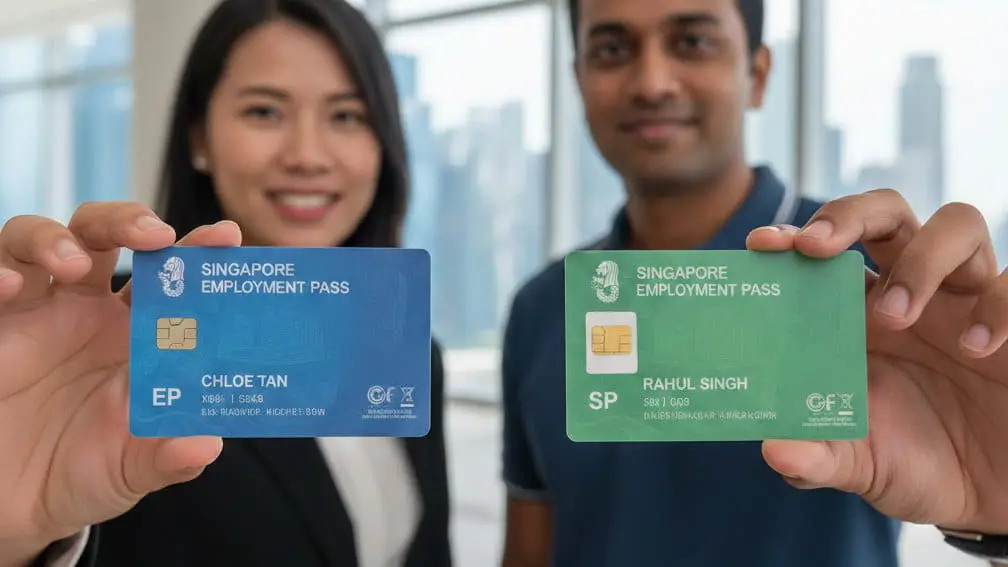
Choosing the right work visa in Singapore is a critical step for employers and international professionals. The decision often comes down to two main options: the Employment Pass (EP) and the S Pass. Both allow you to work and live in the Garden City, but they serve different types of talent and come with different rules.
Getting the choice right is about more than just a job title. It impacts hiring budget, ability to bring family, and long-term residency goals. This guide provides a plain-English look at Singapore EP vs S Pass to help you navigate the Ministry of Manpower requirements.
What Are EP and S Pass?
The EP Pass is for high-level professionals, managers, executives, and specialists. It’s the “gold standard” for white-collar talent, where MOM looks for high salaries and strong academic credentials that prove the candidate brings real value to the economy.
The S Pass is for mid-skilled technical staff – think technicians, junior supervisors, or specialized tradespeople. In the E Pass vs S Pass Singapore comparison, the EP targets the top tier of the workforce, while the S Pass bridges the gap between professional roles and basic work permits. These roles are more common, but the government manages them more strictly.
Who Can Apply
To apply for either pass, you must first have a job offer from a Singapore-registered firm. However, the candidate profile differs significantly between the EP Pass or S Pass:
- EP Applicants usually hold a university degree from a reputable institution and have several years of leadership or specialized experience.
- S Pass Applicants often hold a technical diploma or specialized certifications. They’re hired for roles that require specific skills but don’t necessarily require a full university degree.
Sector also matters. Industries such as manufacturing and construction tend to have higher demand for S Pass holders, while tech and finance are the primary drivers of EP applications.
Salary Thresholds & Assessment
One of the most immediate ways to tell these passes apart is the salary requirement. MOM updates the salary floors regularly to keep pace with the local market.
The S Pass Singapore salary floor is generally lower than that of the EP, making it more accessible for mid-career technical roles. However, for both passes, the minimum salary isn’t fixed – it increases progressively with the applicant’s age. A 40-year-old applicant will need to earn more than a 23-year-old graduate to qualify for the same pass.
For EP candidates, meeting the salary floor is just the first step. They must also pass the COMPASS points system, which evaluates the candidate across four areas:
- Salary relative to local peers
- Qualifications
- Company diversity
- Support for local employment
Quotas, Levies & Fair Consideration
The biggest headache for employers is often the work visa quotas – a major factor in the Singapore EP vs S Pass decision:
- S Pass Quotas. Firms are limited in how many S Pass holders they can hire, based on the percentage of their total workforce. If a company has no quota headroom, it can’t hire another S Pass worker even if the candidate is a perfect fit.
- Levies. Employers must pay a monthly foreign worker levy for every S Pass holder – currently around $650 per month. This makes S Pass hiring a significant ongoing operational expense.
- EP Flexibility. In Singapore E Pass vs the S Pass, the EP has no quota and no monthly levy. However, employers must still demonstrate fair hiring practices by advertising the role on MyCareersFuture for a set period before submitting the application.
Documentation & Processing
Preparing a work pass application requires a solid stack of paperwork. Employers typically need to provide a clear job description and proof of the firm’s financial health. Applicants will need to submit their work visa documents, including:
- A valid passport
- Educational certificates (verified by a third-party agency)
- A detailed work history
Once submitted, MOM reviews the application. Processing typically takes three weeks for an EP and three weeks for an S Pass, though timelines can vary. If approved, you receive an In-Principle Approval (IPA) letter, which allows the candidate to enter Singapore and complete the pass formalities.
Duration, Renewals & Job Changes
A first-time S Pass in Singapore or EP is usually valid for up to two years. Renewals can often be granted for up to three years. Both passes are tied to a specific employer – if you change jobs, your new employer must submit a new application on your behalf. You can’t simply transfer the pass. If the new application is rejected, you cannot legally stay and work for the new company.
Compliance & Employer Responsibilities
MOM takes compliance seriously. Employers must:
- Maintain accurate records of all foreign staff
- Ensure the salary paid matches what was stated in the application
- Notify MOM of any changes in the employee’s job scope or role
Failure to follow these rules can result in heavy fines or a future ban on hiring foreign talent, which is one reason many firms prefer the EP, given its freedom from monthly levies and quota constraints.
Which Pass Fits Your Situation? (Decision Guide)
When evaluating E Pass vs S Pass in Singapore options, ask yourself these three questions:
- Is the role managerial or technical? Strategic and leadership roles almost always require an EP. Technical or operational roles typically fall under the S Pass.
- Does the company have a quota available? Check your S Pass quota balance first. If you’re at the limit, the S Pass is simply off the table regardless of the candidate’s profile.
- What is the total budget? The S Pass has a lower base salary requirement, but the monthly levy adds up over time. In some cases, paying a higher salary to an EP holder is the more cost-effective option overall.
Dependants & Family Options
For many professionals, the ability to bring work visa with family is a key consideration:
- EP Holders can bring a spouse and children on a Dependant’s Pass (DP) if they earn at least $6,000 per month.
- S Pass Holders can also apply to bring family members, but the Singapore EP vs S pass eligibility criteria are more stringent. The option to sponsor parents is reserved for EP holders at higher salary thresholds.
Common Rejection Triggers & How to Avoid Them
Reasons for S/EP pass rejection often come down to the same handful of mistakes:
- Salary mismatch. Offering the bare minimum for an experienced candidate rarely passes scrutiny.
- Incomplete documents. Missing or unverified educational certificates are a top cause of delays and rejections.
- Quota exhaustion. Applying for an S Pass when the firm has already reached its foreign worker limit will result in automatic rejection.
- Weak job matching. If the candidate’s qualifications don’t align with the role – for example, a degree in an unrelated field for a specialized technical position – MOM will likely reject or question the application.
Always use MOM’s Self-Assessment Tool before submitting to catch potential issues early.
Pathways Beyond the Work Pass
Both the S Pass in Singapore and the EP can eventually lead to Permanent Residency. However, the EP is generally viewed as the stronger pathway, as it signals a higher level of professional integration and economic contribution to Singapore.
FAQ
What is the main difference between EP and S Pass?
The EP is for high-level professionals with no quota or levy requirements. The S Pass is for mid-skilled workers and involves employer levies and quota limits.
Which pass is easier to get?
It depends. The EP requires a higher salary and a passing COMPASS score. The S Pass has a lower salary threshold, but the firm must have sufficient quota available, which isn’t always the case.
Can dependents work in Singapore on a Dependant’s Pass?
DP holders need to find an employer who will sponsor them for a work pass before they can legally work in Singapore.
Why are S Pass applications rejected?
Common reasons include the firm running out of quota, the salary being too low for the candidate’s age, or the candidate’s skills not matching the job description.
Can I switch employers on the same pass?
No. Your new employer must apply for a new pass on your behalf before you can begin working for them.
How do I check the status of my S Pass application?
You can check online via MOM’s “Check work pass and application status” eService using your passport number or FIN.


 English
  Chinese
  Japanese